This pattern is for the main subatomic particles that make up all matter in our universe (as well as their corresponding antiparticles). Specifically it covers all the particles that students should be aware of for A-level physics (at least for the exam board that I did). It will also include some explanation about these particles (this is based on my fairly basic understanding from A-level so if anyone feels that the physics is incorrect please do get in touch!)
Note that the exact colours don't matter too much, I've chosen these ones as I feel they go well together.
If you only want to make the particles (i.e. don't care about the antiparticles) the number of each type of particle you make should be halved (i.e. 6 quarks instead of 12). Particles and antiparticles are differentiated based on the embroidery on them (white=particle, black=antiparticle).

Difficulty:


Medium
You will need:
- A 2mm hook
- A 2.5mm hook
- Acrylic dk yarn in red, blue, turquoise, pink, and purple
- Acrylic 4ply yarn in dark red, dark blue, dark pink, light blue, light purple, light green, and orange
- Anchor creativa fino cotton in light green, dark green, light blue, yellow, and dark red
- Black, white, and grey embroidery thread
- 10 sets of 5mm snap fasteners
- Polyester toy stuffing
- A darning needle
- An embroidery needle
- A pair of scissors
Note:
- This pattern includes the back-to-front single crochet stitch (bfsc). A video to show you how to do this can be found here. It's pretty simple but if you can't work it out you can just use a regular single crochet stitch, but this will give it a slightly different look.
For the quarks (make 12 blue, 12 red, and 8 dark pink) :
With a 2mm hook and 4ply yarn make a magic loop with 6sc
Round 1: make 2sc in each st (12sc)
Rounds 2 - 3: (2 rounds) sc in each st
Round 4: sc2tog 6 times (6sc)
Fasten off
With a 2mm hook and 4ply yarn make a magic loop with 6sc
Round 1: make 2sc in each st (12sc)
Rounds 2 - 3: (2 rounds) sc in each st
Round 4: sc2tog 6 times (6sc)
Fasten off
What are quarks?
Quarks are a type of fundamental particle, which group together to form hadrons (see below). There are 6 'flavours' of quarks, with up, down, and strange being the 3 most common (the other flavours are charm, bottom, and top)
You then need to embroider labels onto each of the quarks:
- The blue particles represent down quarks, so you should embroider a white 'd' onto 6 of these, and a black (or dark grey) 'd' with a bar across the top onto the other 6
- The red particles represent up quarks, so you should embroider a white 'u' onto 6 of these, and a black 'u' with a bar across the top onto the other 6
- The pink particles represent strange quarks, so you should embroider a white 's' onto 4 of these, and a black 's' with a bar across the top onto the other 4

Hadrons
For the baryons [protons and neutrons] (make 2 blue and 2 red):
Make a magic loop with 6sc
Round 1: make 2sc in each st (12sc)
Round 2: (sc, make 2sc in the next st) 6 times (18sc)
Round 3: (sc3, make 2sc in the next st, sc4, make 2sc in the following st) twice (20sc)
Round 4: sc2, make 2sc in the next st, sc4, make 2sc in the following st, sc5, make 2sc in the next st, sc4, make 2sc in the following st, sc3 (24sc)
Round 5: (sc12, make 2sc in the next st) twice (26sc)
Row 6: ch8, sc in the 2nd chain st from hook and each of the next 6 chain sts, sc21, ch4
Row 7: bfsc3 down the chain, bfsc29. ch1, turn (32sc)
Row 8: sc in each st. ch1, turn
Row 9: bfsc in each st. ch1, turn
Row 10: sc in each st
Fasten off
Round 11: ch6 , sc in the 8th st of the last round, sc8, sc2tog, sc10 (???)
sc in the first 2 chain sts, sc2tog, sc4, sc2tog, sc5, sc2tog, sc4, sc2tog, sc3
Round 13: (sc3, sc2tog, sc4, sc2tog) twice (18sc)
Round 14: (sc, sc2tog) 6 times (12sc)
Round 15: sc2tog 6 times (6sc)
Fasten off
(make 2)
Make a magic loop with 6sc
Round 1: make 2sc in each st (12sc)
Round 2: (sc, make 2sc in the next st) 6 times (18sc)
Round 3: (sc2, make 2sc in the next st) 6 times (24sc)
Fasten off
These 2 circles need to be sewn inside the first ball you made so that they sit just above and below the opening
What are baryons?
Baryons are a type of particle made up of 3 quarks, always a combination of up and down quarks. They are by far the most common type of hadron found in nature. They make up the nucleus of all atoms - for more information see my atom mobile pattern.
Sew a snap fastener on to the opening of each baryon.


Place quarks inside the particles and embroider as follows:
- Proton: 2 up quarks and a down quarn, embroider a white 'P'
- Antiproton: 2 up antiquarks and an down antiquark, embroider a black 'P' with a bar above it
- Neutron: 2 down quarks and an up quark, embroider a white 'N'
- Antineutron: 2 down antiquarks and an up antiquark, embroider a black 'N' with a bar above it


For the mesons (make 2 in pink, 2 in purple, and 2 in turquoise):
Make a magic loop with 6sc
Round 1: make 2sc in each st (12sc)
Round 2: (sc, make 2sc in the next st) 6 times (18sc)
Round 3: (sc5, make 2sc in the next st) 3 times (21sc)
Round 4: sc9, make 2sc in the next st, sc10, make 2sc in the last st (23sc)
Round 5: ch7, sc in the 2nd chain st from hook and each of the next 5 chain sts, sc17, ch4
Row 6: bfsc in the 2nd chain st from hook and the next 2 chain sts, bfsc23. ch1, turn (26sc)
Row 7: sc26. ch1, turn
Row 8: bfsc26
Fasten off
Round 9: ch5, skip the first 6sts (i.e. the last 6 sts you made on the last round, as shown below), then sc in the next 9sts, sc2tog, sc6 (21sts)

Round 10: sc in each of the 5 chain sts (as shown below), sc2tog, (sc5, sc2tog) twice (18sc)

Round 11: (sc, sc2tog) 6 times (12sc)
Round 12: sc2tog 6 times (6sc)
Fasten off
(make 2)
Make a magic loop with 6sc
Round 1: make 2sc in each st (12sc)
Round 2: (sc, make 2sc in the next st) 6 times (18sc)
Fasten off
Sew these inside the particle in the same way as you did for the Baryons. Sew a snap fastener onto each of the flap openings
What are mesons?
Mesons are a different kind of hadron, similar to baryons but smaller as they contain only 2 quarks. They are produced by high-energy particle collisions, eg. cosmic rays, and decay quickly to release electrons, neutrinos, and photons (see leptons section below).
Insert quarks and embroider as follows:
K+ kaon: (purple) use white thread and insert an up quark and a strange antiquark
K- kaon: (purple) use black thread and insert an up antiquark and a strange quark
K0 kaon: (pink) use white thread and insert an down quark and a strange antiquark
Anti-K0 kaon: (pink) use black thread and insert an down antiquark and a strange quark
pi+ meson: (turquoise) use white thread and insert an up quark and a down antiquark
K+ kaon: (purple) use white thread and insert an up quark and a strange antiquark
K- kaon: (purple) use black thread and insert an up antiquark and a strange quark
K0 kaon: (pink) use white thread and insert an down quark and a strange antiquark
Anti-K0 kaon: (pink) use black thread and insert an down antiquark and a strange quark
pi+ meson: (turquoise) use white thread and insert an up quark and a down antiquark
pi- meson (turquoise) use black thread and insert an up antiquark and a down quark

Leptons
There are 4 different leptons: electrons, muons, tauons, and neutrinos. Neutrinos come in 3 types - electron neutrino, muon neutrino, and tau neutrino. In this pattern I have represented this by giving the electron, muon, and tauon a specific shape, with the corresponding neutrino being the same shape but in a different colour.
For the electron/ electron neutrino (make 2 in light purple and 2 in orange):
Make a magic loop with 6sc
Round 1: make 2sc in each st (12sc)
Round 2: (sc, make 2sc in the next st) 6 times (18sc)
Round 3: (sc5, make 2sc in the next st) 3 times (21sc)
Rounds 4 - 6: (3 rounds) sc in each st
Round 7: (sc5, sc2tog) 3 times (18sc)
Round 8: (sc, sc2tog) 6 times (12sc)
Round 9: sc2tog 6 times (6sc)
Fasten off
Along with protons and neutrons, electrons are the other constituent of an atom. Unlaike baryons they aren't located in the nucleus and are instead found circling around the outside. For more information see my atom mobile pattern.
For the muon/ muon neutrino (make 2 in light blue and 2 in orange):
Make a magic loop with 4sc
Round 1: make 2sc in each st (8sc)
Round 2: (sc, make 2sc in the next st) 4 times (12sc)
Round 3: (sc2, make 2sc in the next st) 4 times (62sc)
Round 4: (sc3, make 2sc in the next st) 4 times (20sc)
Round 5: (sc4, make 2sc in the next st) 4 times (24sc)
Round 6: (sc5, make 2sc in the next st) 4 times (28sc)
Round 7: sc in each st
Round 8: (sc5, sc2tog) 4 times (24sc)
Note that the remaining rounds are slightly more than a single round
Round 9: sc5, sc2tog, (sc4, sc2tog) 3 times (20sc)
Round 10: sc4, sc2tog, (sc3, sc2tog) 3 times (16sc)
Round 11: sc3, sc2tog, (sc2, sc2tog) 3 times (12sc)
Round 12: sc2, sc2tog, (sc, sc2tog) 3 times (8sc)
Round 13: sc, sc2tog 4 times
Fasten off
For the tauon/ tau neutrino (make 2 in green and 2 in orange):
Make a magic loop with 8sc
Round 1: (sc, make 3sc in the next st) 4 times (16sc)
Round 2: sc2, make 3sc in the next st, sc3, make 3sc in the following st, sc3, make 3sc in the next st, sc3, make 3sc in the following st, sc (24sc)
Round 3: sc3, make 3sc in the next st, sc5, make 3sc in the following st, sc5, make 3sc in the next st, sc5, make 3sc in the following st, sc2 (32sc)
Rounds 4 - 11: (8 rounds) sc in each st
Round 12: (sc5, sc3tog) 4 times (24sc)
Note that the next 2 rounds are slightly more than a single round
Round 13: sc4, (sc3tog, sc3) 3 times, sc3tog (16sc)
Round 14: sc2, (sc3tog, sc) 3 times, sc3tog (8sc)
Fasten off
The leptons should be embroidered as shown in the images below. The muons are represented by the greek letter mu and the tauons by the greek letter tau. The symbol for the neutrino is the greek letter nu, with a subscript denoting the type of neutrino.


Exchange particles
Use 4ply cotton and a 2mm hook throughout
These particles help to mediate the forces of the universe. According to the Standard Model there are 4 fundamental interactions - the strong force, the weak force, electromagnetism, and gravitation.
For the W bosons (make 2):
With dark green cotton 4ply and a 2mm hook ch10
Row 1: make 2sc in the 2nd chain st from hook, sc6, sc2tog between the last 2 chain sts. ch1, turn (9sc)
Row 2: sc in each st. ch1, turn
Row 3: make 2sc in the first st, sc6, sc2tog. ch1, turn (9sc)
Row 4: sc in each st. ch1, turn
Row 5: make 2sc in the first st, sc6, sc2tog. ch1, turn (9sc)
Round 6: sc8, make 3sc in the last st, sc3 down the side of the piece you've made (see 2nd image below), make 3sc in the back of the first chain st (3rd/4th images), sc in each of the next 7 chain sts, make 4sc in the last chain st, sc5 up the other side (last image) (35sc)


Round 7: sc in the back loop of each st
Round 8: sc in each st
Row 9: in the back loop of each st: sc9. ch1, turn
Row 10: sc2tog, sc6, make 2sc in the last st. ch1, turn (9sc)
Row 11: sc in each st. ch1, turn
Row 12: sc2tog, sc6, make 2sc in the last st. ch1, turn (9sc)
Row 13: sc in each st. ch1, turn
Row 14: sc2tog, sc6, make 2sc in the last st (9sc)
Fasten off
Fold over the flap created from the last 6 rows, and sew clased, stuffing as you do so.
For the Z boson:
With light green ch14
Row 1: sc2tog between the 2nd and 3rd chain st from hook, sc9, sc2tog between the last 2 chain sts. ch1, turn (11sc)
Row 2: sc in ecah st. ch1, turn
Row 3: sc2tog, sc7, sc2tog. ch1, turn (9sc)
Row 4: sc in each st. ch1, turn
Row 5: sc2tog, sc5, sc2tog. ch1, turn (7sc)
Round 6: sc6, make 3sc in the next st, sc4 down the side of this section (in the same way as you did for the Z boson), make 4sc in the back of the chain st, sc in the back of the next 10 chain sts, make 4sc in the back of the next chain st, sc5 up the other side (36sc)
Round 7: sc in the back loop of each st
Round 8: sc in both loops of each st
Row 9: in the back loop of each st: sc7. ch1, turn
Row 10: make 2sc in the first st, sc5, make 2sc in the last st. ch1, turn (9sc)
Row 11: sc in each st. ch1, turn
Row 12: make 2sc in the first st, sc7, make 2sc in the last st. ch1, turn (11sc)
Row 13: sc in each st. ch1, turn
Row 14: make 2sc in the first st, sc9, make 2sc in the last st (13sc)
Fasten off
Stuff and sew closed in the same way as you did for the W bosons.
The weak nuclear force
The W bosons play a key role in the weak nuclear force, which is involved in nuclear decay. It acts over very small distances and changes the flavour (type) of quarks, allowing baryons to be converted into other baryons. The Z boson also mediates the weak interaction, but it differs from the W bosons in that is's not charged.
For the gluon:
With yellow ch5
Row 1: make 2sc in the 2nd chain st from hook, sc2, make 2sc in the last chain st. ch1, turn (6sc)
Row 2: sc in each st. ch1, turn
Row 3: make 2sc in the first st, sc4, make 2sc in the last st. ch1, turn (8sc)
Row 4: sc in each st. ch1, turn
Row 5: make 2sc in the first st, sc6, make 2sc in the last st. ch1, turn (10sc)
Row 6: sc2tog, sc6, sc2tog. ch1, turn (8sc)
Row 7: sc in each st. ch1, turn
Row 8: sc2tog, sc4, sc2tog. ch1, turn (6sc)
Row 9: sc in each st. ch1, turn
Round 10: sc2tog, sc2, sc2tog, make 2sc in the same st as the 2nd one you made the sc2tog in, sc3 down the side of the section (finishing just above row 6), make 3sc in the hole between rows 5 and 6 (see 2nd image below), sc3 down the rest of this same side (3rd image), make 3sc in the back of the first chain st, sc in the back of the next 2 chain sts, make 3sc in the back of the following chain st, sc3 up the ther side (finishing just below row 5), make 3sc in the hole between rows 5 and 6, sc4 up the remainder of this side (final image) (33sc)


Round 11: sc in the back loop of each st
Round 12: sc in both loops of each st
Row 13: in the back loop only: make 2sc in the first st, sc4. ch1, turn (6sc)
Row 14: sc6. ch1, turn
Row 15: make 2sc in the first st, sc4, make 2sc in the last st. ch1, turn (8sc)
Row 16: sc in each st. ch1, turn
Row 17: make 2sc in the first st, sc6, make 2sc in the last st. ch1, turn (10sc)
Row 18: sc2tog, sc6, sc2tog. ch1, turn (8sc)
Row 19: sc in each st. ch1, turn
Row 20: sc2tog, sc4, sc2tog. ch1, turn (6sc)
Row 21: sc in each st. ch1, turn
Row 22: sc2tog, sc2, sc2tog (4sc)
Fasten off
Stuff and sew closed in the same way as you did for the W bosons.
The strong nuclear force
Gluons are responsible for the strong nuclear force, which binds the quarks within hadrons together, and also binds protons and neutrons together in the nucleus. If you want to learn more I recommend this video on the Strong Interaction.
For the photon:
With light blue yarn make a magic loop with 3sc. ch1, turn
Row 1: make 2sc in the first st, sc, make 2sc in the last st. ch1, turn (5sc)
Row 2: make 2sc in the first st, sc3, make 2sc in the last st. ch1, turn (7sc)
Row 3: make 2sc in the first st, sc5, make 2sc in the last st. ch1, turn (9sc)
Row 4: sc in each st. ch1, turn
Row 5: sc2tog, sc5, sc2tog. ch1, turn (7sc)
Row 6: sc in ecah st. ch1, turn
Row 7: sc2tog, sc3, sc2tog. ch1, turn (5sc)
Row 8: sc in each st. ch1, turn
Row 9: sc2tog, sc, sc2tog. ch1, turn (3sc)
Row 10: sc in each st. ch1, turn
Round 11: sc3tog, sc in the same st as the last one you crocheted into for the sc3tog, sc6 down the side of this section (finishing just above row 5), make 3sc in the hole between rows 4 and 5 (see 1st image), sc3 down the remainder of this side, make 3sc in the magic loop you made at the start (2nd image), sc3 up the other side (finishing just below row 4, see 3rd image), make 3sc in the hole between rows 4 and 5 (4th image), sc7 up the remainder of this section (30sc)
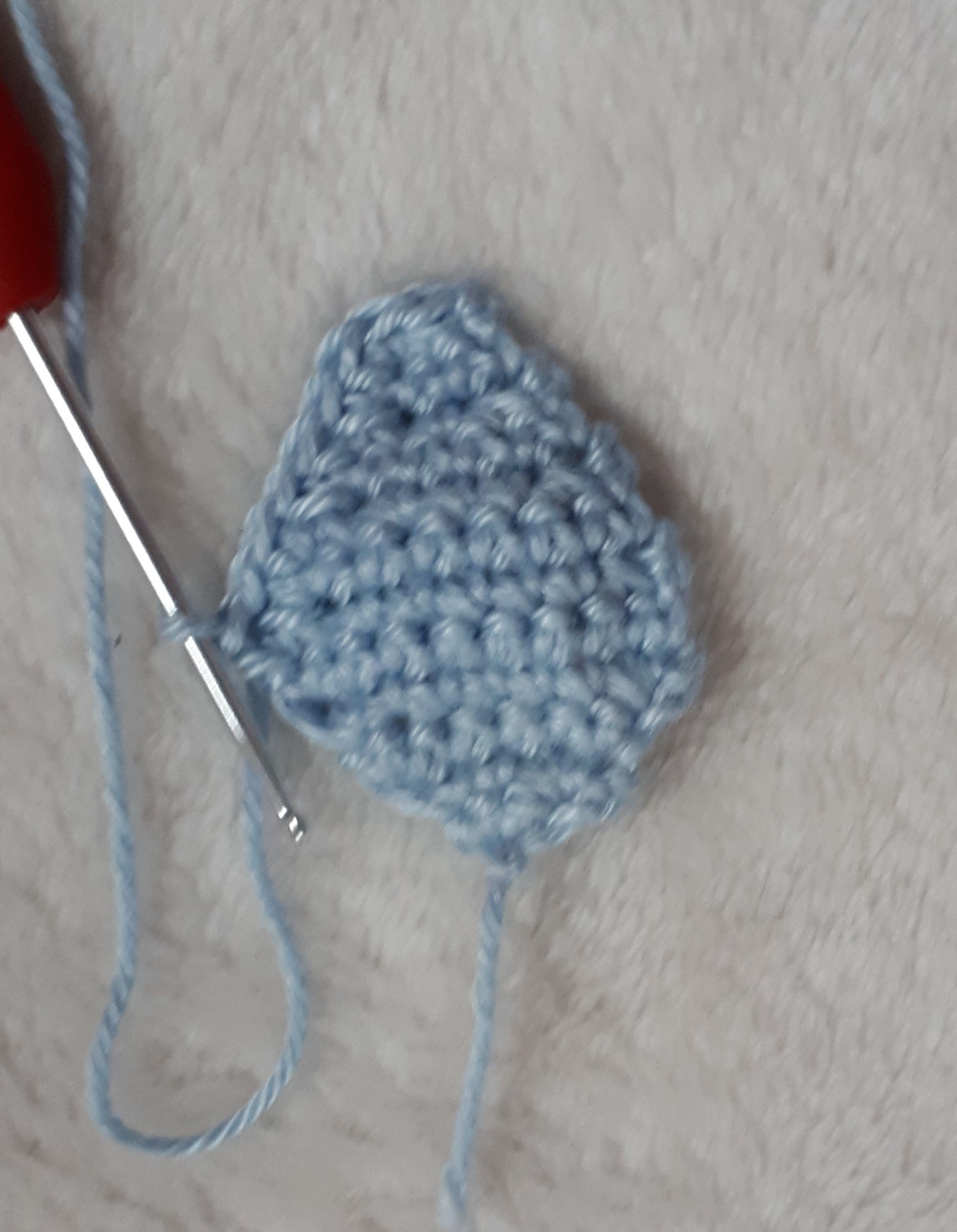

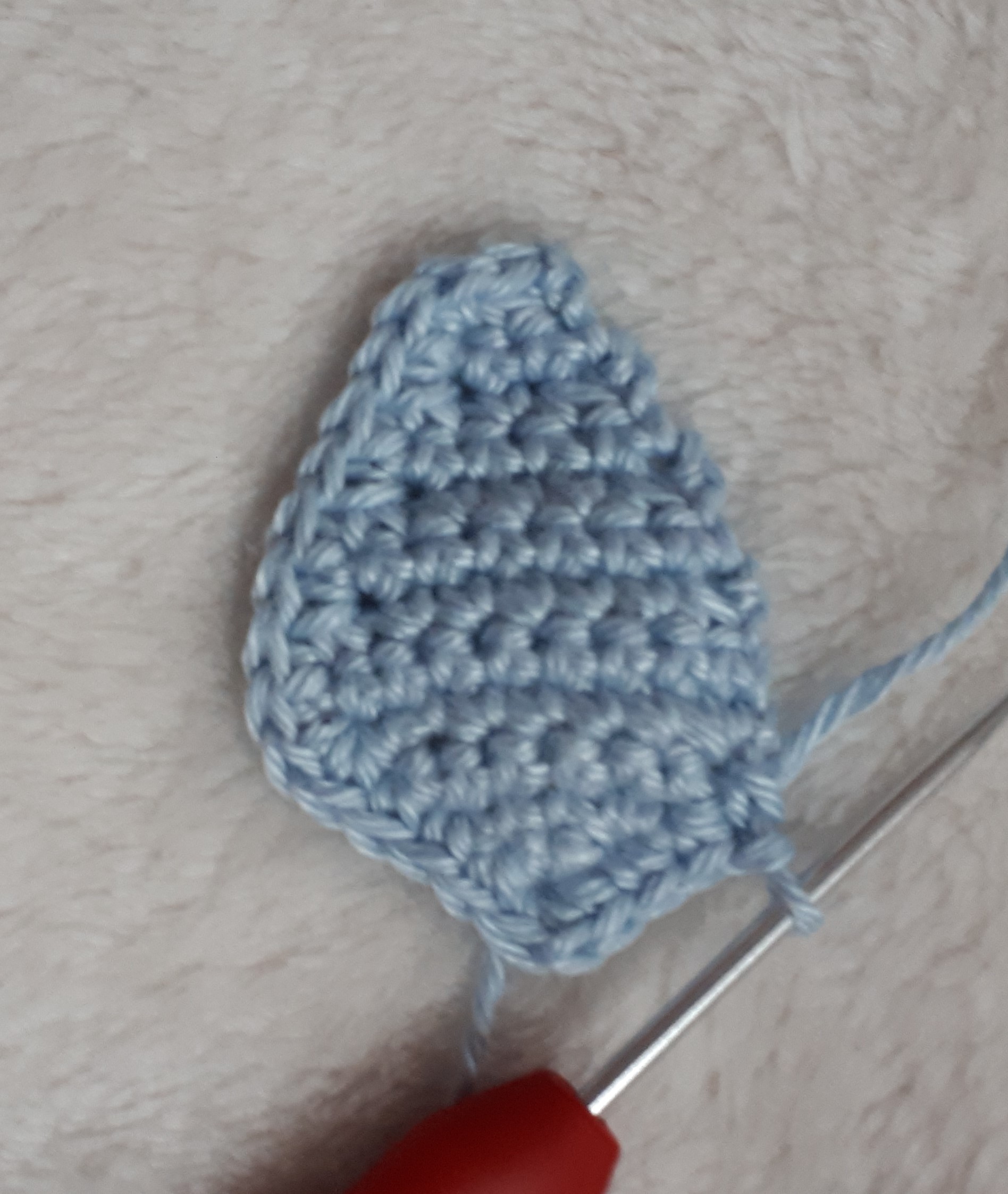


Round 12: sc in the back loop of each st
Round 13: sc in both loops of each st
Row 14: make 3sc in the back loop of this st. ch1, turn (3sc)
Row 15: sc3. ch1, turn
Row 16: make 2sc in the first st, sc, make 2sc in the last st. ch1, turn (5sc)
Row 17: sc5. ch1, turn
Row 18: make 2sc in the first st, sc3, make 2sc in the last st. ch1, turn (7sc)
Row 19: sc7. ch1, turn
Row 20: make 2sc in the first st, sc5, make 2sc in the last st. ch1, turn (9sc)
Row 21: sc9. ch1, turn
Row 22: sc2tog, sc5, sc2tog. ch1, turn (7sc)
Row 23: sc2tog, sc3, sc2tog. ch1, turn (5sc)
Row 24: sc2tog, sc, sc2tog. ch1, turn (3sc)
Row 25: sc3tog (1sc)
Fasten off
Stuff and sew closed in the same way as you did for the W bosons.
Electromagnetism
Photons are the force carriers of electromagnetism. These exhibit wave-particle duality, meaning that they sometimes act like a particle and sometimes like a wave. We encounter electromagnetic waves all the time in the form of visible light, and these waves are also widely used in communications technology (e.g. allowing you to pick up phone signal and access the internet). If you're interested in learning more about this I recommend either this Bozeman Science video or this SciShow video. (The SciShow one is more interesting but potentially harder to understand if you're new to this)
For the higgs boson:
With red ch5
Row 1: sc in the 2nd chain st from hook and each of the next 3 chain sts. ch1, turn (4sc)
Row 2: sc in each st. ch1, turn
Row 3: sc in each st
Fasten off
Row 4: ch4, sc in each of the 4sts of row 4, sc5
Row 5: sc in the 2nd chain st from hook and each of the next 3 chain sts. Sc4, then sc in each of the next 4 chain sts. ch1, turn (12sc)
Rows 6-7: sc in each st. ch1, turn
Row 8: sc in each st. turn
Row 9: slip4, ch1, sc4. ch1, turn
Row 10: sc in each of the first 4sts. ch1, turn (4sc)
Row 11: sc in each st. ch1, turn
Round 12: sc3, make 3sc in the next st, sc2 down the side of rows 9-11, sc in the first 3 chain sts, make 3sc in the next chain st (1st image), sc2 down the side of rows 5-7, make 3sc in the back of the first chain st (image 2), sc in the back of the next 3 chain sts, sc3 down the side of rows 1-3, make 3sc in the first chain st, sc in the back of the next 2 chain sts, make 3sc in the back of the next chain st, sc3 up the other side of rows 1-3, sc in the back loop of the next 3 chain sts, make 3sc in the back of the next chain sts, sc3 up the other side of rows 5-7, make 3sc in the next st, sc in the followoing 3sts, sc2 up the other side of rows 9 - 11, then make 2sc in the gap between rows 11 and 12 (last image) (55sc)


Round 13: sc in the back loop only of each st
Round 14: sc in both loops of each st
Row 15: sc in the back loops of the first 4sts. ch1, turn
Row 16: sc in both loops of the first 4sts. ch1, turn (4sc)
Row 17: sc in each st
Fasten off
Row 18: ch4, sc in each of the 4sts of row 17, sc5
Row 19: sc in the 2nd chain st from hook and each of the next 3 chain sts. Sc4, then sc in each of the next 4 chain sts. ch1, turn (12sc)
Row 20: sc in each st. ch1, turn
Row 21: sc in each st. turn
Row 22: slip4, ch1, sc4. ch1, turn
Row 23: sc in each of the first 4sts. ch1, turn (4sc)
Row 24: sc in each st. ch1, turn
Row 25: sc in each st
Fasten off
Stuff and sew closed in the same way as you did for the W bosons.
Giving mass to particles
The Higgs boson was only discovered relatively recently, after being proposed to explain how fundamental particles are able to have mass. This is explained in more detail in this TED-Ed video.
Embroider the particles as shown below. Since the gluon, photon, and Higgs boson don't have antiparticles it doesn't matter too much what colour you use for them.

That's all from this pattern - I hope you've enjoyed it! If you have any questions about this or any of my other patterns, please feel free to get in contact with me, either by leaving a comment below, emailing them to lhodginscrochet@gmail.com, or via my Ravelry or Instagram pages (email is the best if you're hoping for a speedy reply).
You are very welcome to sell finished products, but I do ask that you please don't re-post this pattern or claim it as your own. Thank you!


